Teaching kids about money — where to start
A child learns about money not from a conversation about it, but from watching how you make decisions. The conversation is only the second step.
“Financial education” sounds like a workshop title for adults. For a five-year-old it comes down to three things there is no way around: money runs out, it has to be earned somehow, choosing one thing means giving up another.
Everything above that — saving, budgeting, compound interest — is built on those three. And none of them can be delivered as a lecture.
What a child actually understands, by age
4–5. Money is an object you swap with. A child does not tell value from size, and does not grasp that a parent has a finite amount. “We cannot afford it” is indistinguishable to them from “I do not want to buy you that”.
5–6. Finiteness appears. A child who gets five coins and sees that after three purchases two are left has taken a real step forward. This is also where the first genuine choice between two things shows up.
6–7. Delay starts to work. A child can hold off spending today to buy something bigger next week — but only if that week is visible (a jar, a calendar, marks on paper). An abstract “sometime later” does not work.
7–8. Where money comes from. Work, a paycheck, bills. This is the moment to tell the truth about the household budget — in general terms, but the truth.
Trying to introduce saving to a five-year-old usually ends with the jar sitting there unnoticed. That is not a character flaw, it is an absent sense of time.
Four habits that do more than conversations
1. Say your choices out loud. In a store: “I am taking this cheese, because that one is twice the price and they taste the same.” Your child gets a ready-made model of how to decide — and that sticks for years. It is the cheapest and most effective item on this list.
2. Let them pay. Physically, in cash, at a real register. Paying by card is invisible to a child — nothing goes away. A bill that disappears is an experience no explanation replaces.
3. Do not rescue them from every bad decision. Your child spent their whole allowance on day one on something that broke within the hour. That is the cheapest financial lesson of their life — and it only works if you do not buy a replacement. This is harder for the parent than for the child.
4. Separate “want” from “need”. One question, asked regularly, is enough: “Is that something you need, or something you want?” No judgment, no moral attached. Naming the difference is the lesson.
Allowance — the one condition without which it does nothing
An allowance teaches only when your child is allowed to spend it badly. An amount the parent steers (“save that”, “not on that”) is not an allowance — it is the parent’s budget with an extra step, and it exercises nothing.
For a younger child the practical settings are simple: pay it the same day every week, make it enough for one small thing but not two, never tie it to normal household chores, and do not top it up when it runs out on Wednesday. That empty pocket on Wednesday is the entire lesson, and it is the part parents find hardest to leave alone.
Where play fits into all this
Play does something real money cannot: it lets a child get it wrong a hundred times at no cost. Which is why the order in practice looks like this:
- Playing store — the mechanics of a transaction, with no stakes. Seven versions for ages 3–9.
- Counting money — the technique: totalling, payment, change. The order worth keeping.
- A real purchase — one item, cash counted out, your child pays alone. How to set up a first solo trip.
- Allowance — decisions that carry consequences.
Steps 1 and 2 run in parallel and last for years. Step 4 without steps 1 to 3 usually ends with a child holding money they cannot count.
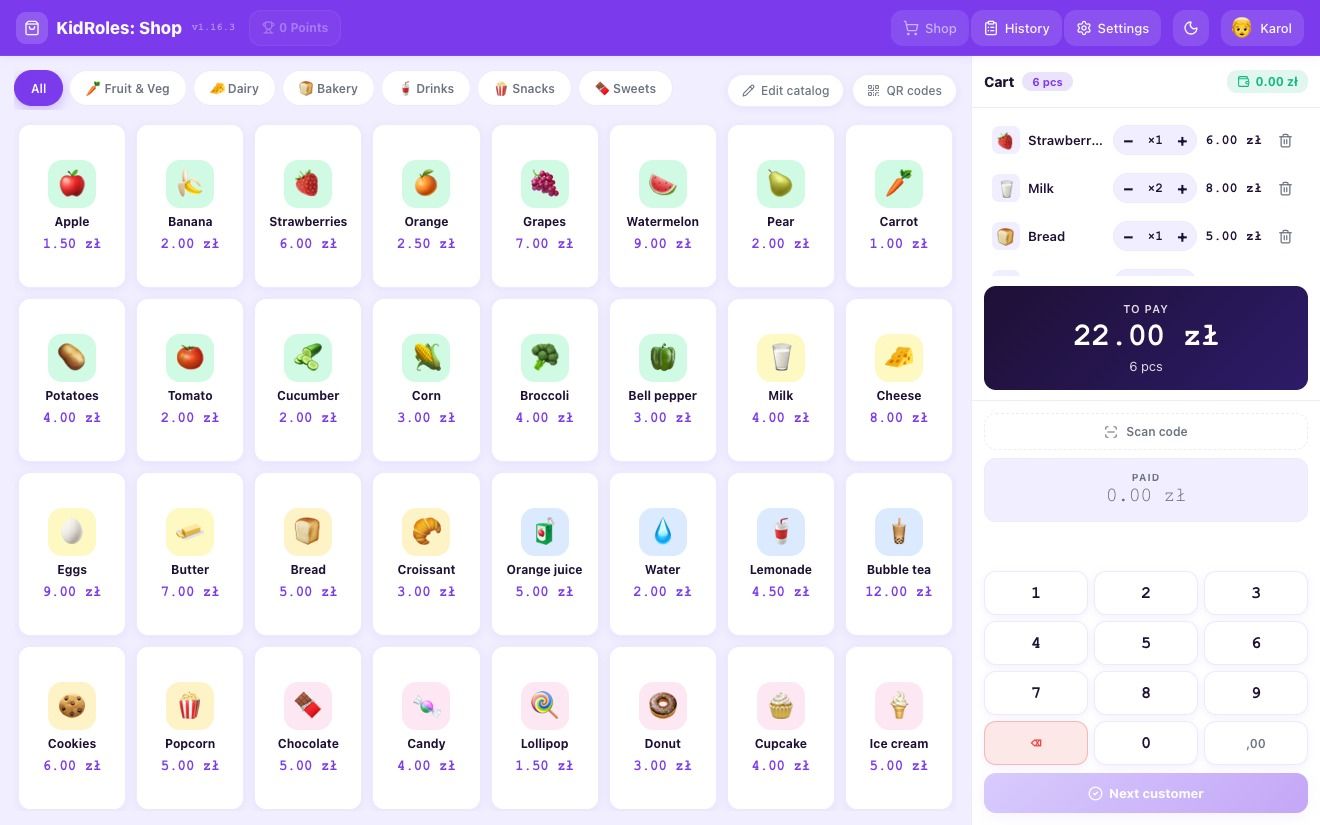
For the “play” part, a tool that gives immediate feedback helps. KidRoles: Shop is a checkout register on a tablet — your child totals the items, takes payment and gives change, and earns points for change that is correct. You set the prices and the product list yourself, so the difficulty follows where your child actually is. It runs offline and collects no data at all — which is, incidentally, a good moment to talk about why free games with ads are not free.
Conversations not worth postponing
“We cannot afford it.” Instead: “We have already spent this month’s money on groceries. We can plan for it next month.” The first version sounds like a shortage, the second like a decision. Children learn from the second.
Where money comes from. Around age seven it is worth showing the chain: work → paycheck → bills → what is left. Without figures, if you prefer — the chain alone is enough. Children who have never seen it assume the ATM simply hands out money.
Ads. “That ad wants you to want this. Somebody paid for it.” In 2026 that sentence matters more than all the counting put together — a child runs into advertising far more often than into cash.
What to avoid
Using money as a threat. A child who mainly hears that there is not enough learns anxiety, not management.
Hiding everything. The other extreme. A house where money is taboo produces adults who do not look at their account balance.
Paying for grades. It turns school into badly paid work. When the rate stops being enough, so does the motivation.
The minimum that is enough
If you were only going to do three things from this whole piece:
- Narrate your buying decisions out loud in front of your child
- Let your child pay in cash themselves at least once a week
- From age 6–7, give an allowance whose spending you do not control
The rest — jars, budgets, spreadsheets — arrives on its own once those three are in place.
Common questions
What age should I start teaching a child about money?
From four or five, but through situations rather than lectures. A five-year-old understands that money runs out and that choosing one thing means giving up another — everything else is built on those two.
Should allowance be tied to chores?
No. An allowance tied to chores turns tidying into paid work, and stops working the day your child decides the rate is too low. Extra jobs beyond the normal ones — washing the car, say — can be paid separately.
How do I explain that we are not buying something?
Instead of "we cannot afford it", say where the money already went: "we spent it on groceries this month, we can plan for it next month". The first version sounds like a shortage, the second like a decision — and children learn from the second.
What comes first: counting or an allowance?
Counting, and in play, where a mistake costs nothing. An allowance without the ability to work out what is left hands a child a decision they have no way to judge.