Playing store with kids — 7 ideas that grow with them
The same game can be stacking cans on a rug or counting change from a twenty. The only thing that changes is where you set the bar.
Playing store has lasted for generations, and not because it looks impressive. It lasts because it is the one game where a child does exactly what they watch adults do — and practises counting, speech and patience without any idea that practice is happening.
The trouble shows up after a week. Your child knows the script by heart, everything costs “ten”, and the whole thing falls apart after ten minutes. Below are seven versions, ordered from simplest to hardest. You do not have to work through them in order — but it helps to know which one sits half a step ahead of your child.
1. Store with no money (ages 3–4)
At this stage money means nothing. What matters is the ritual: handing something over, saying thank you, “what can I get you?”, the bag.
What to set out: five to eight empty packages from the kitchen, something to serve as a counter, a bag.
There is one rule — do not introduce prices. Your child sorts, hands over, packs and talks. That is already a lot of work: sorting objects into groups and taking turns are the foundations you need before counting can stand on anything.
Worth trying: swap roles after a few minutes. Being the customer is harder than it looks — you have to wait your turn.
2. Everything costs one button (ages 4–5)
First contact with the idea of paying, with no arithmetic attached.
Everything costs one. One button, one pebble, one bottle cap. Your child gets a handful of “coins” and discovers that after a few purchases the handful runs out. That is the lesson here, not counting: money runs out.
To extend it: make some items cost one and others cost two. Suddenly you have to count to two and check whether you have enough. For a four-year-old that is a serious decision.
3. Prices up to five (ages 5–6)
Real math starts here, and this is where it usually falls apart — because the adult jumps straight to prices like “$3.50”.
Stay with whole numbers up to five. Two items at a time, no more. Your child adds them up: “two and three is five.” They pay exactly, no change.
Only once adding is smooth, introduce paying over the amount: the customer hands over five, the goods cost three. How much comes back? That is the first subtraction in their life that means anything, because somebody is standing there waiting for those two dollars.
4. Price tags and a shopping list (ages 6–7)
You add one thing: the list. The customer arrives with a piece of paper (drawings or words) and your child has to fill the order.
That turns the game from reactive into planned. You have to remember, check, tick off. It works beautifully alongside learning to read — a shopping list is the shortest text a child will ever read voluntarily.
Harder version: a list with a budget. “You have ten dollars, buy three things.” Now something has to be given up — and that is a lesson nobody learns from being told.
5. Making change (ages 7–8)
Giving change is the moment playing store starts to teach for real.
Your child has to run three operations back to back: add the prices, take the payment, subtract. Under the pressure of a customer who is watching.
Start with round amounts: the total is $7, the customer pays $10. Then $6.50 out of ten. If your child gets lost, drop back a level — do not explain harder. A game that requires sitting through a lecture stops being a game within two minutes.
6. Receipts and a register (ages 8–9)
At this stage a child can carry the full cashier role: several items, a receipt, closing the shift and counting the till.
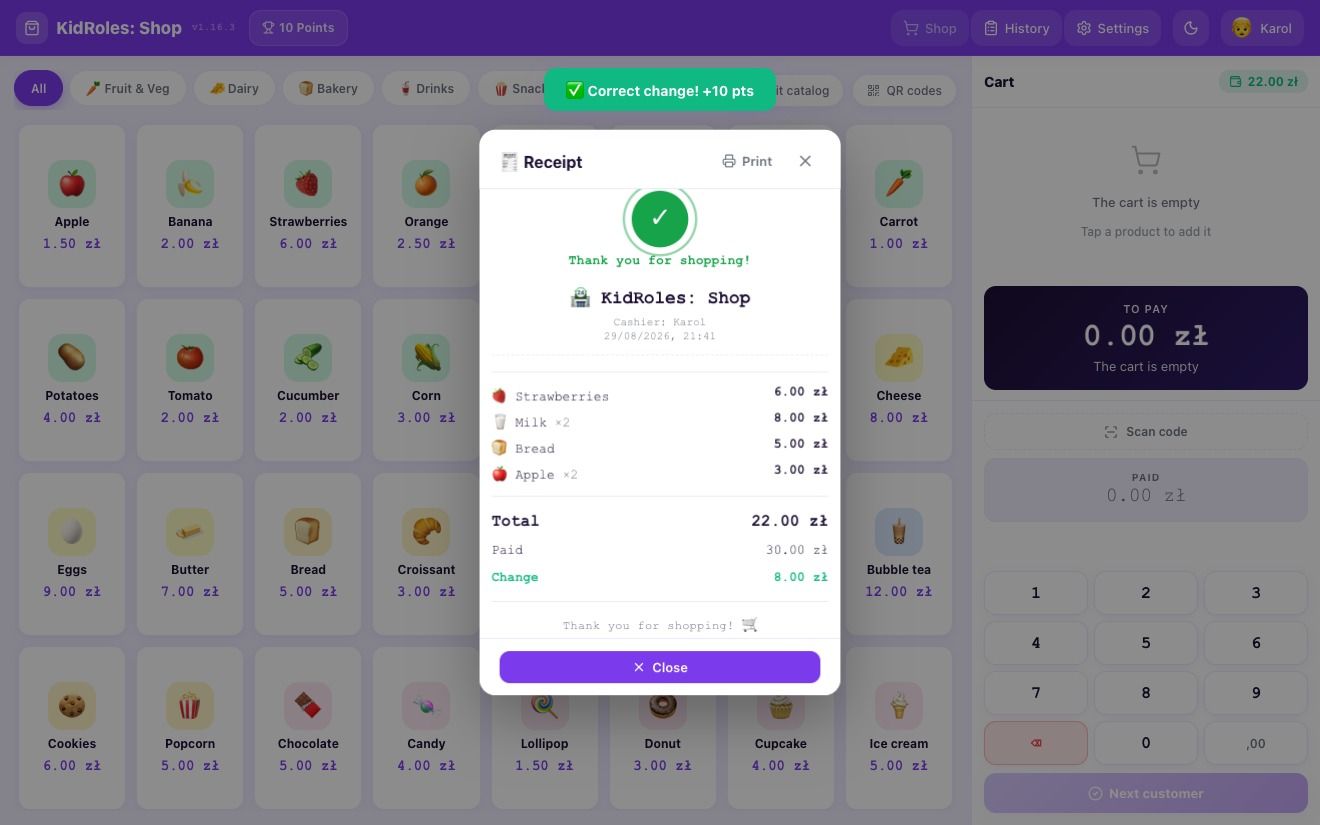
This is where a tablet earns its place. The app takes over the bookkeeping — totals, receipt, history — leaving your child with the part they are meant to practise: taking payment and giving change. KidRoles: Shop works exactly this way: a phone can act as a wireless barcode scanner paired with the tablet acting as the register, so you scan the real packaging from your own kitchen and set the prices yourself.
The practical gain: your child sees the mistake immediately. No waiting for an adult to check it.
7. A store that turns a profit (ages 9+)
The last level is playing at running a store, not at being a cashier.
Your child sets the prices, works out whether the takings covered “buying the stock”, and decides what to order next time. Deals appear — “second item half price” — which happen to be excellent fraction practice.
At this point the game quietly turns into a conversation about money, and that is the best possible moment to have one. There is more on that in the rest of the guide.
What not to do
Three habits ruin playing store more effectively than having no toys at all:
Correcting mid-game. If your child hands back the wrong change, nothing bad happens. The customer can say “hmm, I think you gave me too much” — and that is enough. A correction from inside the role is part of the game; a correction from the parent ends it.
Too much stock. Twenty products is not a well-stocked store, it is a mess. Six to ten items will carry an hour.
Rushing. Playing store lives at the pace of conversation. Hurry kills the most valuable thing in it — the long, unhurried sentences your child builds on their own.
Set this up once and keep it
- a box of empty product packaging (clean, light, nothing sharp),
- a handful of “coins” — real small change works, if your child no longer puts things in their mouth,
- paper for price tags and lists,
- optionally a tablet with an app, once your child reaches level 5 or 6.
That is the whole list. Playing store does not need an $80 wooden shop — it needs somebody to walk in for bread and ask how much they owe.
Common questions
What age can kids start playing store?
Around three, but without money — the child trades one item for another and practises the ritual itself: hand it over, say the words, take it back. Coins only make sense once a child can count to five, usually around age five.
What do you need to play store at home?
A few empty packages from the kitchen, hand-written price tags, a basket and a box for the money. Real packaging beats a plastic play set, because your child already recognises it from the shelf.
How do I know when to move up a level?
When your child gets through a whole sale without glancing at you for approval. It is not about being correct — it is about being independent. As long as they are still checking your face, stay where you are.
Does playing store teach anything besides counting?
Yes, and that is the stronger half of it. Your child practises talking to someone they do not know, waiting their turn, swapping roles and speaking in full sentences. Counting is only one of several things happening at once.