Grocery store dramatic play — setting up the center
A grocery store center is the rare setup where language, early math and turn-taking all happen at once — and where children keep going long after an adult would have stopped.
A grocery store is the most reliable dramatic play center there is, and the reason is simple: every child in the room has been in one. There is no scaffolding needed for the premise. They arrive already knowing the script.
What varies enormously is how much the center actually teaches, and that comes down to three setup decisions most classrooms make quickly and then never revisit.
Stock it with real packaging
The single biggest upgrade is replacing the plastic play food with empty product packaging sent in from home. Cereal boxes, pasta boxes, rinsed yogurt cups, egg cartons, coffee cans.
Three reasons, in order of importance:
The print is real. A cereal box carries a brand name, a weight, a nutrition panel, an ingredient list. A child handling it is handling print in a context where print has a purpose — which is exactly what a print-rich environment is supposed to mean.
Recognition drives language. A child who spots the box from their own kitchen has something to say about it. Plastic food produces “I am buying food”; a real box produces “my brother eats these but I do not like them”.
It is free and it renews itself. A note home refills the shelf every few weeks, and rotating the stock refreshes the center without dismantling it.
Two practical cautions: ask families to rinse and dry anything that held food, and cut off or tape over any sharp cardboard edges from opened boxes.
Put print on the walls, not just on the shelf
A grocery center with no writing in it is a housekeeping center with boxes. The print is what turns it into a literacy activity:
- Section signs — Produce, Dairy, Bread. Children can make these themselves, which is better than laminated ones you made over the weekend.
- Price tags — hand-written, on index cards, changed often.
- Shopping lists — blank pads by the entrance. Early writers draw; later writers write.
- Receipts — a pad by the register. A receipt is the shortest authentic writing task in the room.
- Open / Closed sign — surprisingly powerful for managing the center’s rhythm.
The lists and receipts do the most work, because they are the only items where a child produces print rather than reading it.
Give the roles names
Conflict in this center is almost never about space. It is about the register.
Naming four roles solves most of it: cashier, bagger, and two shoppers. Write them on cards and hang them at the entrance. Children rotate through by moving a name tag, not by an adult adjudicating.
The bagger role is the one people leave out, and it is the most underrated: it is pure sorting and classifying — heavy on the bottom, cold things together, eggs on top — with a built-in reason to talk about categories.
Differentiating inside one center
A mixed-age group can run the same center at four difficulty levels at once, without splitting it:
| Level | What the child does | Skill |
|---|---|---|
| Trading | Hands over an item, no money | Turn-taking, script |
| One token | Everything costs one token | One-to-one correspondence |
| Prices to five | Two items, whole numbers | Adding within five |
| Change | Pays over, gets change back | Counting up |
The differentiation lives in the price tags, not in the setup. Two children can be at the same counter working at different levels, and neither has to know that.
Keep it up longer than you want to
Most classrooms rotate a center out after two weeks. With a grocery store that is a mistake, because the arc runs like this:
- Week one — exploration. Children handle everything, the play is loud and shallow.
- Week two — routine. The script settles. This is where it looks finished, and is not.
- Week three — complexity. Deliveries appear. Someone runs out of stock. Prices change. A child invents a coupon.
Week three is the payoff and most centers get packed away in week two. Rotate the stock, not the center: swap in a bakery section, add a scale, introduce a second cashier.
Where a tablet fits, and where it does not
A register app is worth adding at exactly one point: when children reach the change stage and an adult can no longer stand there checking every total.
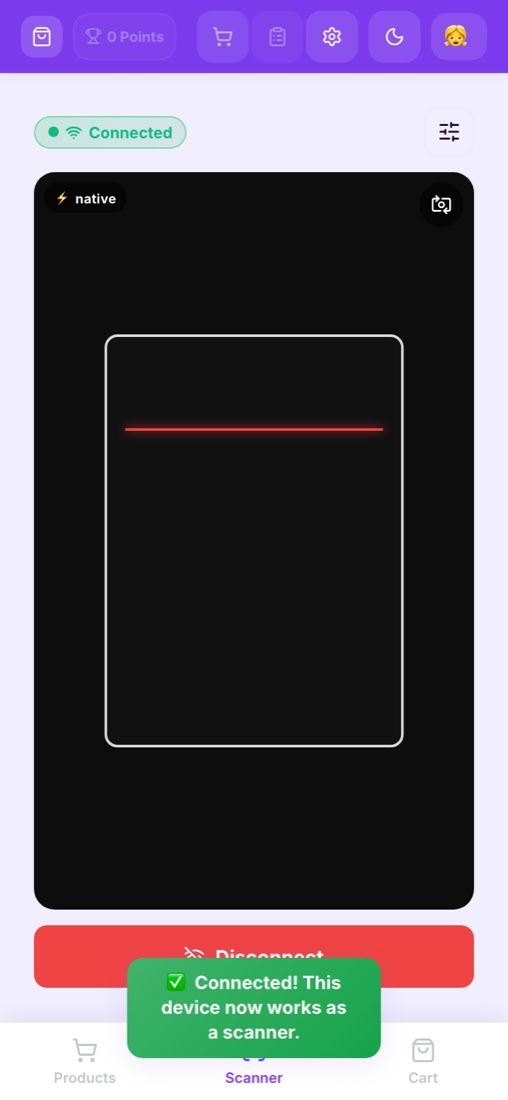
KidRoles: Shop was built for this. It runs on a tablet as the register, and a phone can pair with it as a wireless barcode scanner — so children scan the real packaging already on your shelf rather than a fixed set of pictures. Each child gets a profile with a four-digit PIN, so a group shares one device without overwriting each other’s work, and the app prints a sheet of QR codes you can stick onto packaging that has no barcode left. You set the prices, which is where the differentiation table above actually lives. It runs offline and collects no data about children — nothing to set up, no accounts, nothing that leaves the device.
Where a tablet does not belong is the shopping itself. The walking, choosing, talking and bagging is the part that carries the language, and a screen shortens all of it. One device at the register, none anywhere else.
What it is actually teaching
Worth having on hand when somebody asks:
- Oral language and vocabulary — the strongest gain, and the hardest to see on a checklist.
- Print awareness — reading signs and packaging, producing lists and receipts.
- One-to-one correspondence — one token, one item; one bag, one customer.
- Sorting and classifying — stocking the shelf and bagging.
- Counting and early addition — as far as your price tags reach.
- Turn-taking and negotiation — built into the roles.
That set maps onto most early learning frameworks without redesigning anything. The center does the work; the documentation is just naming what already happened.
If you want the home version of the same activity, with the difficulty ladder written out by age, it is here: playing store with kids. And the counting-up method the change stage depends on is explained in teaching kids to make change.
- Real packaging, rinsed, edges taped
- Signs, price tags, list pads and a receipt pad
- Four named roles on cards at the entrance
- Price tags set to the level of the children using it
- Rotate the stock at three weeks, not the whole center
Common questions
What do I need to set up a grocery store dramatic play center?
Empty product packaging from families, a low shelf, baskets, a counter, paper money or tokens, and a lot of paper for signs and lists. Real packaging beats a plastic play set, because children recognise it and the print on it is real print.
How long should a dramatic play center stay up?
Longer than most classrooms keep it. The first week is exploration, the second is routine, and the third is where the play gets genuinely complex. Rotating out after two weeks removes it right before the payoff — rotate the stock instead.
How many children can play at once?
Four works well: cashier, bagger and two shoppers. Naming the roles matters more than limiting the number, because conflict in this center is almost always about who gets the register, not about space.
What standards does it cover?
In practice: oral language and vocabulary, print awareness, one-to-one correspondence, sorting and classifying, counting, and turn-taking. It maps onto most early learning frameworks without needing to be redesigned for any of them.