How to teach kids to count money
Counting money looks like counting. It isn’t — five coins on the table can be worth five cents or a dollar and a quarter, and nothing about the pile tells a child which.
Short answer: kids learn to count money in stages — first that a coin’s value has nothing to do with its size, then counting one kind of coin, then a mixed handful, then dollars and cents, and only at the end giving change. Each stage is practiced with real coins rather than on paper, and the next one starts when the current one runs without help. Below are the stages one by one, then the same ground by age and grade.
Counting money looks like counting, so the natural assumption is: “my child can count to a hundred, so this will be easy.” Then you put five coins on the table, ask how much is there, and the answer is “five”.
That answer isn’t exactly wrong. It’s an accurate count of the coins. Money asks for something else: counting by value, with a step that changes from one coin to the next. That’s three skills in one, and children pick them up in order:
- a coin’s value has nothing to do with its size,
- counting by 1s, 5s, 10s and 25s — and switching between them mid-count,
- reading and writing amounts in dollars and cents.
Change comes after all three. Here’s the order that works, and where it’s worth slowing down.
Stage 0: value, not size (ages 4–5)
Before any counting, your child has to accept something that looks absurd: a small coin can be worth more than a big one. U.S. coins make this harder than most. The dime is the smallest coin in your pocket and is worth twice as much as the nickel; the penny is bigger than the dime and worth a tenth of it.
Exercise: lay out a penny, a nickel, a dime and a quarter, and ask your child to line them up “from the one that buys the least to the one that buys the most.” Not from smallest to biggest. It’s the first time your child has to trust a label over their own eyes, and it takes a while.
Don’t rush this stage. Children who skip it go on counting coins instead of cents for a long time — “I’ve got five coins, so I’ve got five cents.”
Stage 1: one kind of coin at a time (ages 5–6)
Start with pennies only. A sticker costs 7¢; your child counts out seven pennies and hands them over. That’s the whole transaction, and it already practices the core move: counting out an exact amount from real objects.
Then one kind of coin at a time, each with its own step:
- pennies by ones — 1, 2, 3…
- nickels by fives — 5, 10, 15…
- dimes by tens — 10, 20, 30…
This is skip counting with something in your hand, and it’s the first place where money meets the counting your child does at school. The quarter waits. Counting by 25s — 25, 50, 75, a dollar — is worth practicing on its own once the other three are easy.
Stage 2: a mixed handful (ages 6–7)
Now the step changes in the middle of a count, and this is where most children stall.
The rule that makes it work: sort first, largest coin first. A quarter, two dimes, a nickel and three pennies: “twenty-five… thirty-five, forty-five… fifty… fifty-one, fifty-two, fifty-three.” Left alone, children count coins in the order they happen to lie, and lose track at the first switch.
Two things help. For the first few weeks, have your child name the coin before each step (“quarter, twenty-five — dime, thirty-five”). And keep the handful small, three or four coins, until switching steps stops being a struggle.
Equal amounts belong here too: 25¢ is a quarter, but also two dimes and a nickel, or five nickels. The idea that the same value comes in different coins is exactly what change depends on later.
Stage 3: dollars and cents (ages 7–8)
Next comes the notation. $1.35 is one dollar and thirty-five cents; a hundred cents make a dollar, and so do four quarters or ten dimes. Children read price tags long before they understand the dot, so make it concrete: build $1.35 from a dollar bill, a quarter and a dime, then from coins only.
Now your child can pay an exact price. One item first: the tag says $1.35, build it. Then two items, which means adding the prices to a total before paying. Keep the counting on the table, not in the head: your child puts down the first item and says “one dollar”, puts down the second and adds “and fifty cents — one fifty.” The gesture holds the number. Totals in the head come later, on their own.
This is roughly the ground Common Core covers in second grade, in standard 2.MD.C.8.
Stage 4: paying more and counting up the change (ages 7–9)
Only now does change make sense. The total is $7, your child pays with a ten, and somebody has to work out what comes back.
Teach it as counting up, not subtraction: from $7 to $10 is “eight, nine, ten — three dollars back”, the way cashiers do it. It uses only the counting your child already has, and the money laid down along the way is the answer. Whole dollars first, then quarters, then any amount of cents. Change has its own sticking points, so it has its own guide: teaching kids to make change covers the order of amounts and what to do when a count goes off the rails.
Counting money by age and grade
The ages above are approximate, and children in one class can easily be two stages apart — a six-year-old already counting mixed coins next to an eight-year-old still sorting them. Treat this as a map, not a norm: the starting point is always what your child does without help.
Ages 4–5: preschool and pre-K
Realistic goal: knows that things in a store have to be paid for, sorts coins by value rather than size, counts pennies to ten. Exercise: a pretend store where everything costs one or two pennies and the purse runs empty after a few purchases. Too early for: mixed coins, dollars and cents, change.
Ages 5–6: kindergarten
Realistic goal: names the penny, nickel, dime and quarter, and counts out an exact price in pennies. Starts counting nickels by fives and dimes by tens. Exercise: prices up to 20¢, paid with one kind of coin.
Ages 6–7: first grade
Realistic goal: knows what each coin is worth, writes amounts with the ¢ sign, and counts a small collection of pennies, nickels and dimes by skip counting. Exercise: “make 35¢ two different ways.” Common Core doesn’t list money until second grade, but many state standards and classroom programs bring coins in here — Texas, for example, puts coin values and the cent sign in first grade.
Ages 7–9: second and third grade
Realistic goal: counts mixed collections with quarters and dollar bills, reads $ and ¢, solves word problems with prices, then makes change from $5 and $10 by counting up. In Common Core states this is standard 2.MD.C.8. In England, Year 2 combines amounts in pounds and pence and introduces giving change, and Year 3 extends change to pounds and pence together. Exercise: a shopping list with a budget, and the full cashier role with a receipt.
Teachers will find the standards side by side, with how a class store fits each one, on our page for preschools, kindergartens and schools.
Fun ways to practice counting money
None of these needs a worksheet:
The coin jar. Tip out the household coin jar and sort it into piles by value. Then count one pile by its step. It’s stage 0 and stage 1 at once, and the jar refills itself.
A store at home. Real packaging from the pantry, handwritten price tags, a purse of coins. The difficulty lives in the price tags — single cents for a five-year-old, $1.35 for a seven-year-old. Seven versions by age are in playing store with kids.
A class store. In a classroom the same game becomes a center with named roles, wall print and price tags the children write themselves — set up as described in grocery store dramatic play.
The real store. The math at the shelf — totals, comparing prices, unit price — is in grocery store math for kids. One question per trip is plenty.
Worksheets, real coins or an app?
Real coins first. Recognizing and counting coins is a physical skill: size, color, the ridged edge of a dime or a quarter. Play coins get all of that wrong, so children learn the toy instead of the money. The U.S. Mint stopped making pennies for circulation in 2025, but they’re still legal tender, still in every coin jar and still in the second-grade standard — keep them in the set.
Counting money worksheets come after the coins, as a check. A drawing of a quarter has no weight and no edge, so a worksheet mostly tests whether your child recognizes the picture. Once real coins are counted reliably, a worksheet is a good way to see whether the skill carries over to paper — which is how it will be tested at school.
An app helps with the checking. Plenty of apps promise to teach kids how to count money; what matters is who does the counting. Look for three things: the app checks your child’s answer instead of producing it, you set the prices yourself, and there are no ads or in-app purchases — a three-minute check for that is in ad-free games for kids.
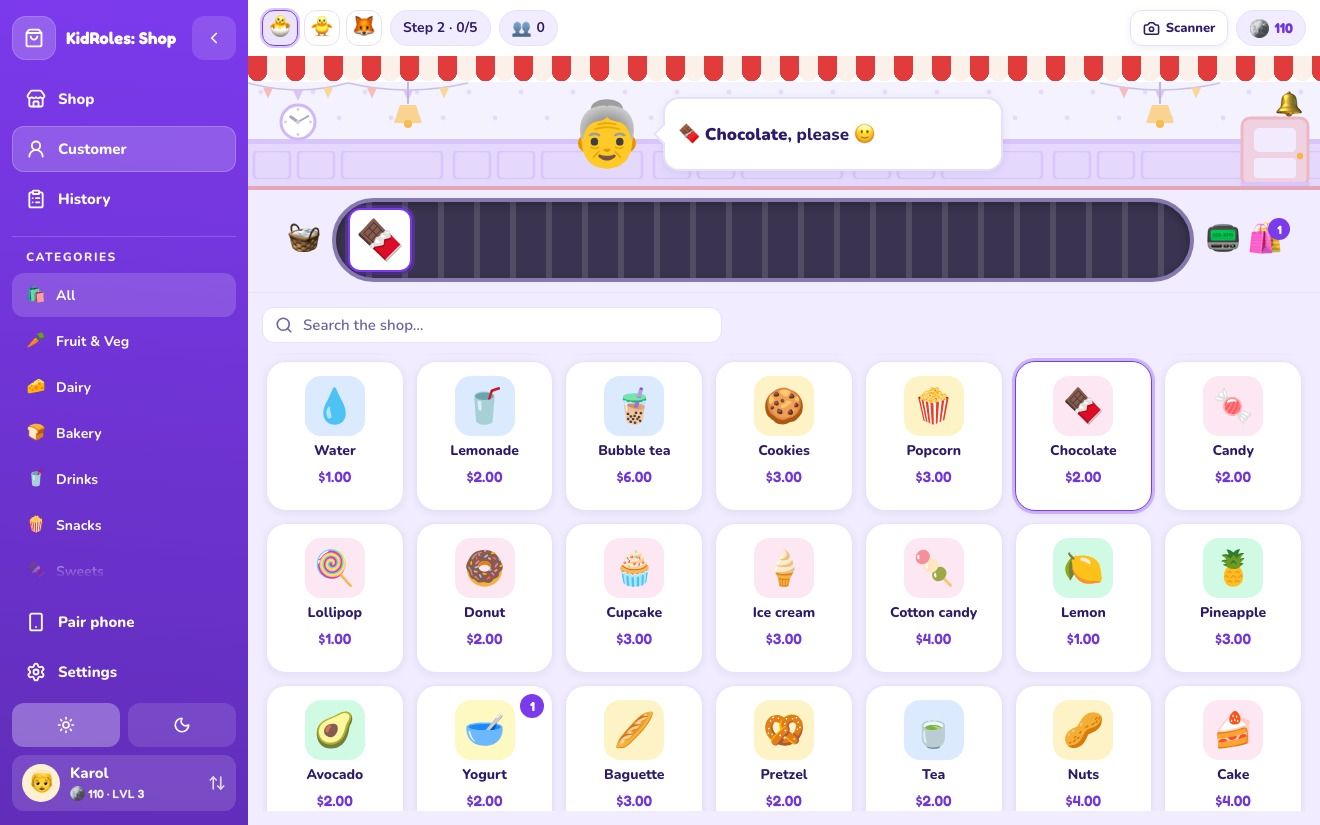
KidRoles: Shop is built that way. A tablet becomes the register: your child totals the items, takes payment and gives change, and correct change earns coins and new cashier levels — feedback in a second instead of after an adult checks the work. In dollars (the default in English outside the UK and Ireland) the payment tray has a 50¢ coin, a $1 coin and bills; pennies, nickels, dimes and quarters stay on the table as real coins, which is where stages 0 to 2 belong anyway. In Customer mode a shopper puts items on the conveyor belt and, on higher levels, pays with a bill and waits while your child counts the change out from the tray. It runs offline and collects no data.
Three mistakes that cost the most time
Starting with mixed coins. A handful of four different coins mixes two difficulties at once: knowing the values and switching the counting step. Your child decides that money is “hard”, and that sticks.
Correcting mid-count. A wrong total is worth more than a right one supplied by an adult. Wait two or three seconds in silence; children very often fix it themselves, and an interrupted count has to start over.
Mistaking counting for understanding. A child who counts change fluently doesn’t necessarily know where money comes from or why you can’t buy everything. That’s a separate conversation, with its own starting points by age: teaching kids about money.
How to tell it’s time to move on
A simple test at the end of each stage: your child does it without looking at you. Not “without a mistake” — on their own, without searching your face for confirmation after every number. While they’re still checking with you, stay at the same level. That isn’t lost time; it’s the only way the next stage won’t turn into guessing.
Once stage 3 is solid, take it outside. A single prepared purchase in a real store does more than another week of practice at the kitchen table — how to set one up is in your child’s first solo shopping trip.
Common questions
At what age can kids count money?
Most children can name the coins in kindergarten and count a pile of one kind by first grade. Counting a mixed handful of quarters, dimes, nickels and pennies usually settles around seven, and making change around seven to eight — but the stage your child is at matters more than the birthday.
What grade do kids learn to count money?
In Common Core states, money sits in second grade: standard 2.MD.C.8 asks for word problems with dollar bills, quarters, dimes, nickels and pennies, using the $ and ¢ symbols. Many states start earlier — Texas, for example, has coin names in kindergarten and coin values in first grade. In England, coins and notes come in Year 1 and giving change in Year 2.
Which coin should I teach first?
The penny, because one coin is one cent and counting works the way your child already knows. Then the nickel and the dime, which turn counting by 5s and 10s into money, and the quarter last — counting by 25s is the hardest step and leans on everything before it.
Real coins, play money or worksheets?
Real coins for recognizing and counting: play coins have the wrong sizes and colors, so children learn the toy instead of the money. Play money is fine for a store game with a group. Counting money worksheets work best as a check after the coins, not as the way in — a drawing of a coin has no size, no edge and no weight.
How long should we practice each day?
A few minutes, but often. Five minutes at the checkout or one transaction in a game every day does more than a long session once a week.